Here is a compilation of many postings from Symphonic Health's list that may be helpful to you. I already uploaded into one file all the pictures of the spider and it's bite's effects.... Hope you find this helpful.
General Information:
Brown Recluse Spider Bite: For all who indulge in yard work, cleaning your attics and sheds, beware...This is primarily for those of you who live where these nasty little guys reside.
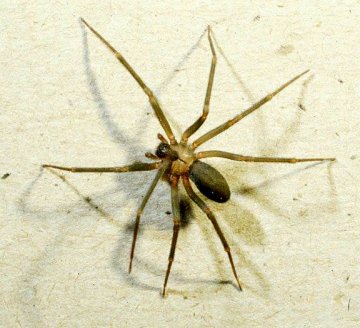
Brown Recluse Spider Bite: The following illustrates the progression of a brown recluse spider bite. Just as a warning, day 3-6 photos are not too graphic. However, day 9 and 10 are very graphic. Your discretion is advised if you choose to view.
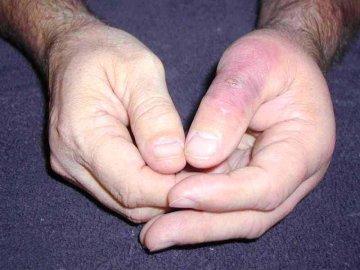 Day 3 |
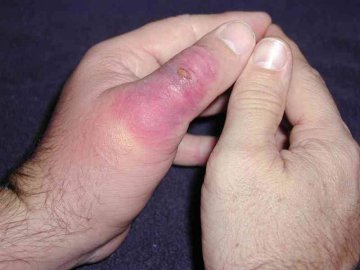 Day 4 |
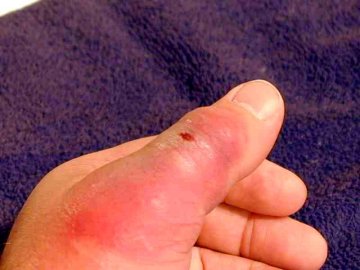 Day 5 |
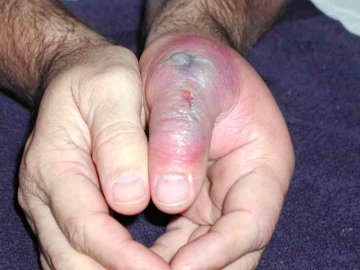 Day 6 |
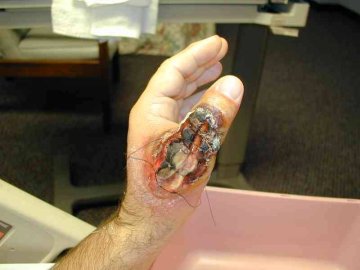 Day 9 |
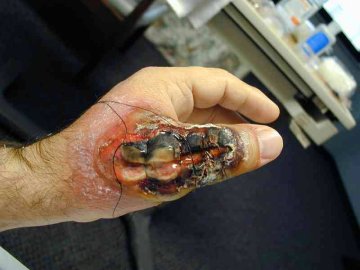 Day 10 |
Now we all should know what to look out for. I thought this would be a good thing to send around to people before summertime when people are going to be digging around doing yard work, etc.
Please be careful, spider bites are dangerous and can have permanent and highly negative consequences. FYI - They like the darkness and tend to live in storage sheds or attics or other areas that might not be frequented by people or light. If you have a need to be in your attic, go up there and turn on a light and leave it on for about 30 minutes before you go in to do your work.
The Following posts are some helpful ideas & considerations if one chooses to try something alternative. They are experimental and to be tried at your own risk.
VoicePrints Wrote:
We discussed these photos on my master herbalist list. A practitioner friend out
west actually treated a little girl for a recluse bite... respectfully, the guy
in the pic was already treated with the best that the drug industry could offer.
My friend had the little girl all done with it in a week.. Used plantain
poultice to draw out the poison, Echinacea, and I
think she also used a zapper electric current on it...
Cheryl
DC Current vs. Spider Bites
http://www.highway60.com/mark/brs/osborn.htm
stun gun for treatment of insect and snake bites .
From: "mkathryn59" mkathryn59@yahoo.com
Black salve will kill the bite and heal it. We have already tried it on several bites with people and they are very pleased. It works on it just like on skin cancers. One young man of about 19 yrs had 2 bad spots on his legs and they were getting bigger and very red. We put the salve on them and it healed them in about 10 days. All the red left in about 5 or 6 days and the core of poison came out and the places healed very nicely.
This is something people sure need to have in their medicine cabinet.
Just thought I would pass this along to you.
Posted by : Larry Coats
Although my frequency research on the Brown Recluse Spider bite is not complete,
I have found the following additional frequencies that have been beneficial.
They are: 884, 1830, 3260, 30,008.
From: Lynn Buckley
If you'd like an adjunct to rife, the Homeopathic remedy Ledum palustre is
excellent for spider bites...
Lynn
From: "Jeff Sutherland"
Analyzing the photo at the site below shows an infection in the lesion with frequency 767766. I commonly find frequencies in this range for mite infections and other insects. Whatever this infection is, protein or living organism it replicates rapidly, is highly infectious, and is extremely noxious. The brown recluse can be deadly. I just had a cat die mysteriously and took careful photographic records. Analyzing the photos, I pick up exactly 767766. He probably ate the spider as there were no external lesions. My wife did not want to do an autopsy.
Looking at the brown recluse in one of the photos that was posted, I searched for a target to disable them. There appears to be a bacteria in its digestive tract with frequency 444434. I find infections in people with this frequency often, particularly when they have animals with insect infections. Knocking this organism out might eliminate the recluse via starvation or organ system malfunction. This frequency can be broadcast with an Advanced Biophoton Analyzer and I routinely use this strategy to eliminate insect, fungus, and mold infestations. For heavy infections, I power up my EM7 plasma device running a scalar octave of these frequencies to get down below 10000hz and blast right through walls. Needless to say, after the loss of the cat, the brown recluse terminator will be deployed.
Knowing precisely how to determine the frequency of the infectious component and how to deal with it quickly should make even a brown recluse bite a minor affair. Someone with an F-SCAN should be able to do this when bitten.
Jeff Sutherland
http://frequencyresearch.org/